Sunday, March 15, 2009

mommy, where do gingers come from?

This is too good not to share.

Scientists at Oxford University believe that the so-called ginger gene, which is responsible for red hair, fair skin and freckles, might be up to 100,000 years old. A 2001 discovery indicates that the gene possibly originated in – dun dun dun – the Neanderthal man.

Yeah, Neanderthals had red hair. How did I not know that? Professor L. sure didn’t mention that one in Anthropology 100.

For those of you who didn’t take that highly... interesting... class (or who memorized everything for the exam and forgot it the next day like me), Neanderthals are thought to have been a less intelligent species than modern man, Homo sapiens. They were taller and stockier, but had shorter limbs, broader faces and noses, receding chins and low foreheads. Language-wise, they functioned at the level of your lovable local two-year-old. They settled down and made themselves comfy in Europe about 300,000 years ago, but 260,000 years later, a wave of new folks (our ancestor, Cro-Magnon Man) jaunted over from Africa and the two species co-existed happily for 10,000 years. Pretty happily, all right. The Oxford research, presented at a London conference of the Human Genome Organization back in ‘01, implies that the two species must have interbred for the ginger gene to survive. Neanderthals were hotties!

Some scientists believe Neanderthals were ultra-humans, able to adapt to climate extremes. They did survive for 272,000 years before the bigger-brained Cro-Magnons got cranky and decided they didn’t want to share the resources anymore.

My favorite part of the whole thing is how paranoid the scientists are that redheads will be insulted at the Neanderthal link.

Me no offended. Me, redhead. Me have super-human gene!

PS. If you don't like this creation myth, my roommate suggested that redheads were originally born out of the ground as carrots. Hey, your guess is as good as mine.

Wednesday, March 11, 2009

keep out of direct sunlight

My friends, I am about to journey to a land of great peril. Sun, sand, sea, four-star luxury, mojitos on the beach. Vitamin D, Cuba style. Did I mention sun? I’m as good as dead.

See, I have a problem. I recently lost a paleness contest against a bowl of vanilla ice cream. And SPF 50 is the highest I’ve ever managed to find.

A friend told me this summer, as he hopped off his motorboat onto the Sproat Lake dock I was standing on, that he’d used me as a homing beacon to find the spot. “Just wave your arms around and you’re a perfect lighthouse,” he said. I was not flattered.

I’m a little sensitive in that department. I don’t tan. I don’t even freckle. The darkest I can ever aspire to become, in the torrid heat of August, is the colour of a normal person in wintertime. I’m in denial of this fact – summer after summer, I languish for hours on the lawn or the lakeshore against friends’ exasperated advice and retreat home at the end of the day nursing freshly lobstered skin.

This July I thought I’d finally done it. Look, everyone! Tan lines! They squinted and peered, unsure. They made me stand against a white-painted wall. They debated amongst themselves in hushed tones. I was jubilant. Until the skin in question promptly peeled off and I was forced to start over – tabula rasa. Thank you, Solarcaine.

Needless to say, I was not excited at the prospect of enduring this trauma six months before I’d normally be donning a bikini and venturing beyond the door (or in front of a mirror, for that matter).

I realize that I simply suffer from an unfortunate case of genetics. Melanin in the skin aids UV tolerance through tanning, but fair-skinned people lack the levels of melanin needed to prevent UV-induced DNA damage. Studies have shown that red hair alleles in MC1R cause increased freckles and decreased tanning ability – and that individuals with pale skin are highly susceptible to a variety of skin cancers, especially melanoma.

Cover up, everyone says, fondly condescending. Don’t be stupid. You’ll just burn.

Maybe this time I’ll listen. I’ll stay away from those coffin-like beds, stick to my SPF 50 and slather on some self-tanner. Maybe all the stares and pointing from toned, tanned Varadero vacationers won’t be due to my Casper the Friendly Ghost impersonation. Maybe, just maybe, they’re secretly jealous of my glowing health!

Yeah, that’s it.

Sigh. I would have been so much cooler if I’d been born during the Renaissance

Sunday, February 1, 2009

just a daywalker

He said it between forkfuls of lasagna and Caesar salad.

“So, did you get kicked today?”

I stared at my uncle over my wine-glass and tried to form a coherent response. He chewed, nonchalant. I felt the awkward discomfiture of someone on the cusp of an inside joke, but a glance around the table told me no one else was getting it, either. And then came the epiphany, personified in my mind’s eye as Eric Cartman’s flabby face. I made a physically improbable snort-laugh noise into my Merlot.

Last year, as one of many convenient distractions from my studies, I became a South Park fan. In an online stash of old episodes, nestled in 2005’s Season Nine, I discovered the infamous #9.11: “Ginger Kids”. I clicked. And proceeded to erupt in sporadic giggles for the next twenty-three minutes.

The episode begins as perpetually malevolent Eric Cartman delivers a hate speech for his class presentation. “Ginger kids,” he counsels his schoolmates, “are born with a disease which causes very light skin, red hair, and freckles. This disease is called Gingervitis, and it occurs because ginger kids have no souls.” He compares the ginger gene to vampirism, because gingers are cursed and must avoid sunlight. He says that Judas was a redhead, and what did Judas do? He killed Jesus.

When red-haired Kyle objects with fury, saying he doesn’t have to stay out of the sun, Cartman explains that Kyle is in a separate category of “daywalkers,” people with red hair but lacking light skin and freckles. The other children agree. Ginger kids are promptly barred from the cafeteria; they shuffle sadly into the hallway with their paper-bag lunches.

You can blast South Park all you want. It’s crude, it’s crass. But it often says what everyone else is too afraid to say – with politically incorrect metaphors, of course. Personally, I’m convinced it’s all in good leftist fun.

In this case, the thinly-veiled comparison to racism stems from so-called gingerism, a discriminatory phenomenon prevalent in the UK but virtually unheard of in Canada. Sure, I’ve been called ‘carrot-top’ and ‘ginger’. But affectionately – never as insults. And admittedly, I’ve lived it up; for Halloween I’ve dressed up as Pippi, Little Red Riding Hood, and an authentically kilted Scot. Red hair is a built-in costume accessory. I’ve felt that it sets me apart, in a way, but I’ve never actually felt ashamed.

This past November, three years after the episode aired, a fourteen-year-old boy from Courtenay, BC created a Facebook group to promote an event. “National Kick a Ginger Day,” designated as November 20, 2008, attracted over 4,700 members. Its tagline? “Get them steel toes ready!” The friend who sent me the link thought it was pretty funny. I did, too.

Problem was, some kids really did get kicked. One 13-year-old recalls being hit at least 80 times. Some came home with bruises. Some refused to go to school at all, frightened by threats all week preceding the infamous date. And Canada… well, Canada freaked out. Teachers, school administrators and anti-bullying activists across the nation saw red (sorry, it was too easy).

So, the group was shut down. The teen issued a public apology, after a little friendly nudging from the local police department. Screenshots of hateful Facebook posts flashed between South Park clips on CBC. Poor misguided children, influenced by a terrible TV show!

No one in the real world seems to acknowledge that by the end of the episode, the situation reverses itself. Cartman gets a taste of his own medicine; the rest of the gang sneak into his room at night, dye his hair red, bleach his skin, and tattoo henna freckles on his face. Upon awakening, Cartman promptly proclaims gingers to be a superior race and founds a Red Power movement. But no, South Park is bad. It corrupts our children.

I'm not saying that little kids should be watching it. But... come on.

I survived the day miraculously kick-free. No pokes, no nudges, not a single friendly tap, even. And until Uncle Mark spoke up I’d forgotten completely about the occasion. I guess I’m not a real ginger kid – I’m just a second-class daywalker, not good enough for people’s shoes.

Monday, January 26, 2009

redheadday!

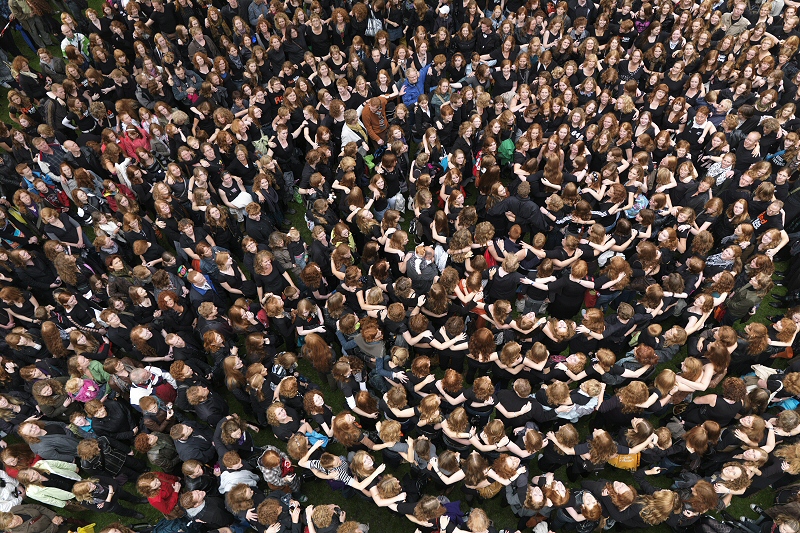
If you happen to be passing through the Netherlands next year on the first weekend of September (hey, you never know), you might want to make a stop in Breda. The city, I've just discovered, hosts an extensive annual two-day redhead festival. About 2000 redheads from 15 countries made it for redheadday 2008, and its organizers project an attendance of 5000 in 2009. Last year, some Dutch calendars even set the celebration in stone, and officially designated the first Sunday of September as redheadday.

Redheadday began in 2005 as an idea of the Dutch painter Bart Rouwenhorst in the small city of Asten. The first festival drew 150 natural redheads. At the time, the event competed for publicity in Asten's newspapers with a local pumpkin contest. Owch. Then the Dutch national press got wind of it and redheadday made headline news.

The festival, now sponsored by the Dutch government and featuring free admission, moved to the larger venue of Breda in 2006. Redheadday is a myriad assemblage of art exhibitions, lectures, workshops and demonstrations, all geared specifically towards the red-haired sector of the world's population. The event's highlight, though, is a massive, organized-chaos redhead photoshoot on the final day. That's a lot of gingers.

Take that, pumpkin contest!